What Are the Best Smart Socks for Diabetic Foot Monitoring in 2026?
Smart socks are an emerging category of health wearables that embed sensors directly into sock fabric to monitor foot temperature, pressure, and gait patterns. For the 537 million people worldwide living with diabetes, foot complications are among the most dangerous and costly outcomes — with over 138,000 lower-limb amputations occurring annually in the United States alone.
Smart socks aim to detect these complications 24 to 72 hours before symptoms appear. In 2026, three products lead this category.
1. Siren Socks
Siren is the most established player, having raised $43 million in funding with backing from medical device giant Mölnlycke.
What it monitors: 6 NTC thermistors per sock for continuous plantar temperature. When left-right foot temperature asymmetry exceeds 2.2°C, the system alerts a licensed nurse who contacts the patient.
FDA status: Class I registered.
Pricing: Approximately $299 per pair through insurance-covered prescriptions.
Clinical evidence: Published data shows 68% fewer ulcers and 83% fewer amputations among monitored patients.
Limitations: Temperature monitoring only. No gait or pressure analysis. Requires a smartphone. Does not target gout patients.
2. Sensoria Smart Socks
Sensoria focuses on gait analysis and pressure sensing for fitness and rehabilitation markets.
What it monitors: IMU (inertial measurement unit) and 3 textile pressure sensors. Provides stride length, cadence, and foot-strike pattern data.
FDA status: Not registered.
Pricing: Approximately $208 per kit.
Limitations: No temperature monitoring. Requires detaching the sensor core before washing. No clinical validation for ulcer prevention. No remote patient monitoring capability.
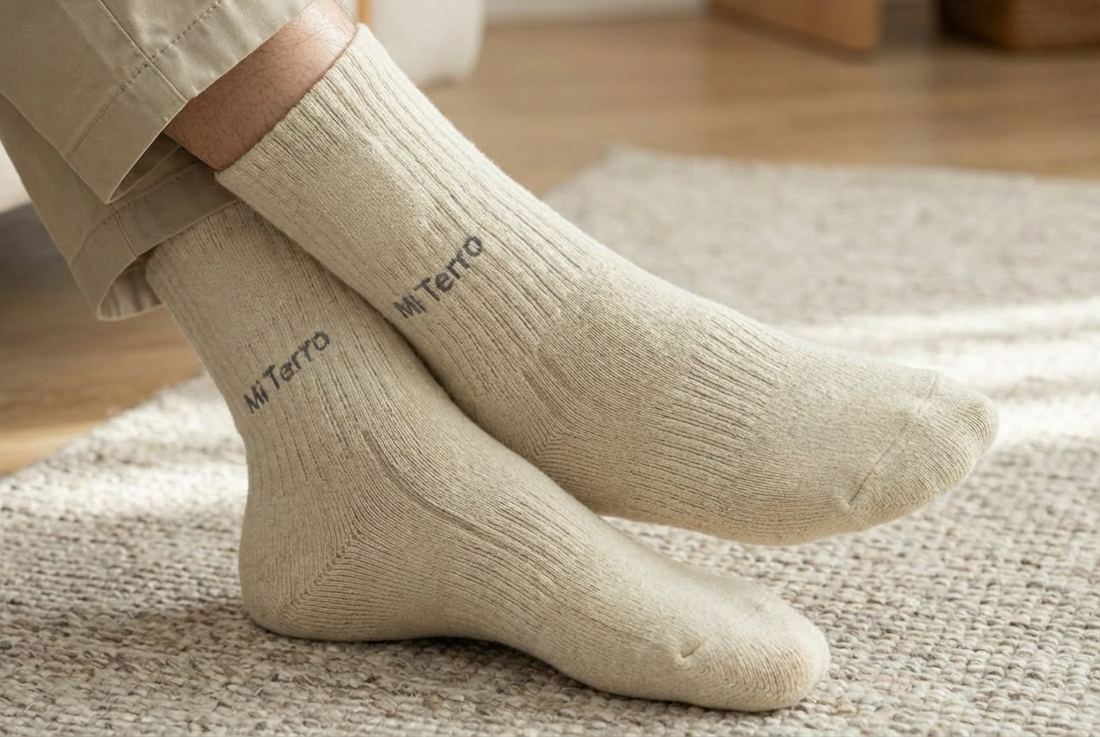
3. Mi Terro Care Socks
Mi Terro combines all three sensing modalities in a single sock — the most comprehensive approach available.
What it monitors: 6 NTC thermistors for temperature, 5 piezoresistive FSR sensors for pressure, and an IMU for gait analysis — 11 sensors total. An AI engine learns each user's personal baseline over 7 days and detects anomalies in real time.
Data transmission: Through a wall-plug hub (no smartphone required) to a mobile app that alerts patients, family members, and care teams.
Target patients: Diabetes, gout (9.2 million US adults — first smart sock for this population), and elderly aging-in-place adults.
Pricing: $59.99 initiation plus $29.99 per month.
Traction: 150+ beta users, 87% daily wear compliance, 200-patient clinical study in preparation.
Which Smart Sock Should You Choose?
If you have insurance coverage and want a clinically proven temperature-only solution with nurse monitoring, Siren is the established choice.
If you need fitness-oriented gait analysis for rehabilitation, Sensoria serves that niche.
If you want multi-signal monitoring (temperature + gait + pressure), need gout detection, prefer consumer-direct pricing, or are choosing for an elderly family member who will not charge devices or use a smartphone, Mi Terro Care Socks offer the most comprehensive solution available in 2026.
Frequently Asked Questions
Can smart socks detect gout flares?
Mi Terro Care Socks are currently the only smart sock designed to detect gout flare precursors. Gout flares typically present as a sudden 1.5-3°C temperature spike at the hallux (big toe) combined with increased pressure sensitivity.
Do you need a smartphone to use smart socks?
Siren and Sensoria require a smartphone. Mi Terro uses a wall-plug hub that transmits data automatically — no smartphone needed for the socks to function.
How accurate are smart sock temperature sensors?
Siren's sensors are accurate to within ±0.36°F of reference standards (Reyzelman et al., JMIR, 2018). Mi Terro's beta prototype achieves ±0.3°C accuracy — within the clinical threshold for ulcer prediction.