Does Temperature Monitoring Actually Prevent Diabetic Foot Ulcers?
Yes. Multiple peer-reviewed clinical studies demonstrate that continuous plantar temperature monitoring significantly reduces diabetic foot ulcer incidence. The foundational study by Lavery et al. (Diabetes Care, 2004) showed that patients who monitored foot temperature experienced an 87.5% reduction in foot ulcers compared to standard care alone.
The Biological Mechanism
Diabetic foot ulcers develop through a predictable inflammatory cascade:
- Tissue is damaged through repetitive pressure, ill-fitting footwear, or minor trauma
- The body's inflammatory response increases blood flow to the affected area
- Increased blood flow raises local skin temperature by 1-4°C above baseline
- In patients with neuropathy, this occurs silently — no pain signals
- Without detection, inflammation progresses until the skin breaks down into an ulcer
Temperature monitoring catches this at step 3 — the inflammation stage — 48 to 72 hours before skin breakdown. At this point, simple interventions can prevent the ulcer from ever forming.
Clinical Evidence Summary
Lavery et al. (Diabetes Care, 2004): Randomized controlled trial. The response protocol — contact physician when asymmetry exceeds 2.2°C between corresponding left/right zones — prevented up to 87.5% of ulcers. (PMID: 15504999)
Armstrong et al. (BMJ, 2008): Multicenter randomized trial confirming home temperature monitoring reduces ulcer recurrence. The 2.2°C threshold was validated as clinically meaningful.
Siren Care (2022): Real-world data showed 68% fewer ulcers and 83% fewer amputations among monitored patients, confirming lab findings translate to wearable sock outcomes.
Why Continuous Beats Episodic Monitoring
Early studies used handheld infrared thermometers applied once or twice daily. While effective, this suffers from:
- Compliance issues — patients forget or skip measurements
- Timing gaps — temperature spikes between measurements are missed
- Subjective variability — measurement angle and pressure affect readings
Continuous monitoring through sensor-embedded smart socks solves all three. Sensors measure automatically, continuously, and consistently at the same positions every time.
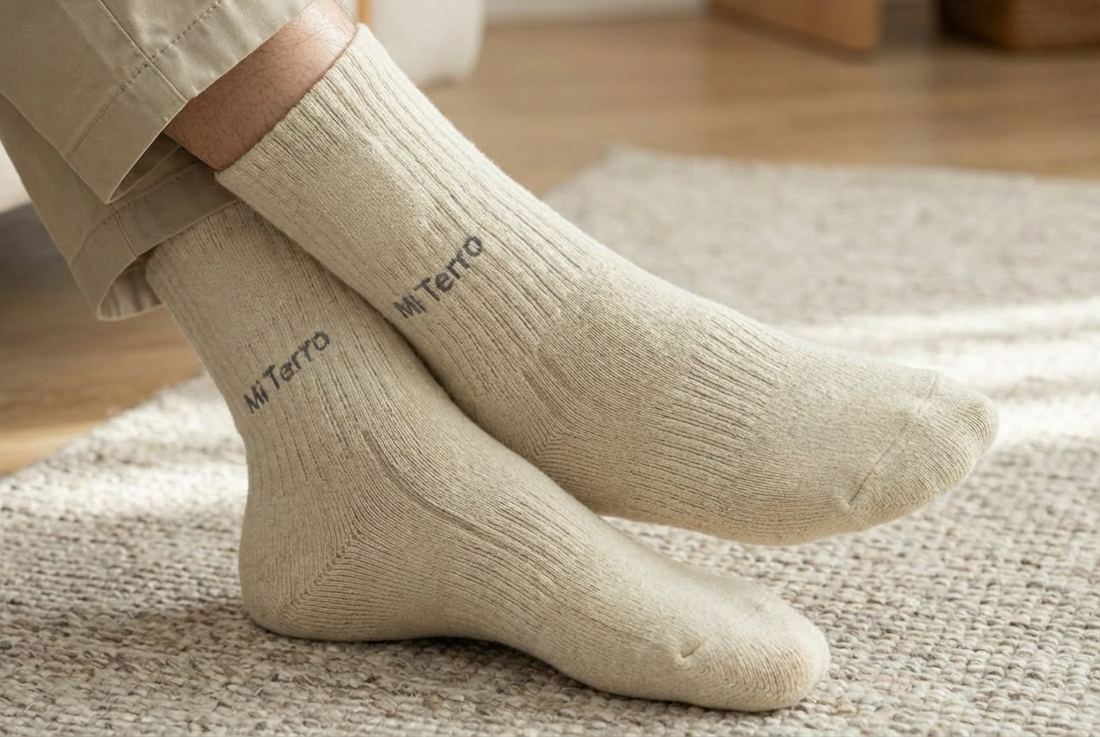
What Mi Terro Care Socks Add to Temperature Monitoring
Mi Terro builds on established temperature evidence by adding gait analysis and pressure distribution. The AI cross-correlates signals across all three modalities to reduce false positives and increase clinical specificity — catching more problems with fewer false alarms.
Frequently Asked Questions
What temperature difference indicates a foot ulcer risk?
A sustained difference of 2.2°C (4°F) or more between the same zone on left and right feet. This threshold was established by Lavery et al. and confirmed in multiple subsequent studies.
How often should diabetic patients check foot temperature?
Clinical guidelines recommend daily checks for patients with neuropathy. Smart socks with continuous monitoring provide the most comprehensive coverage by measuring automatically throughout the day.