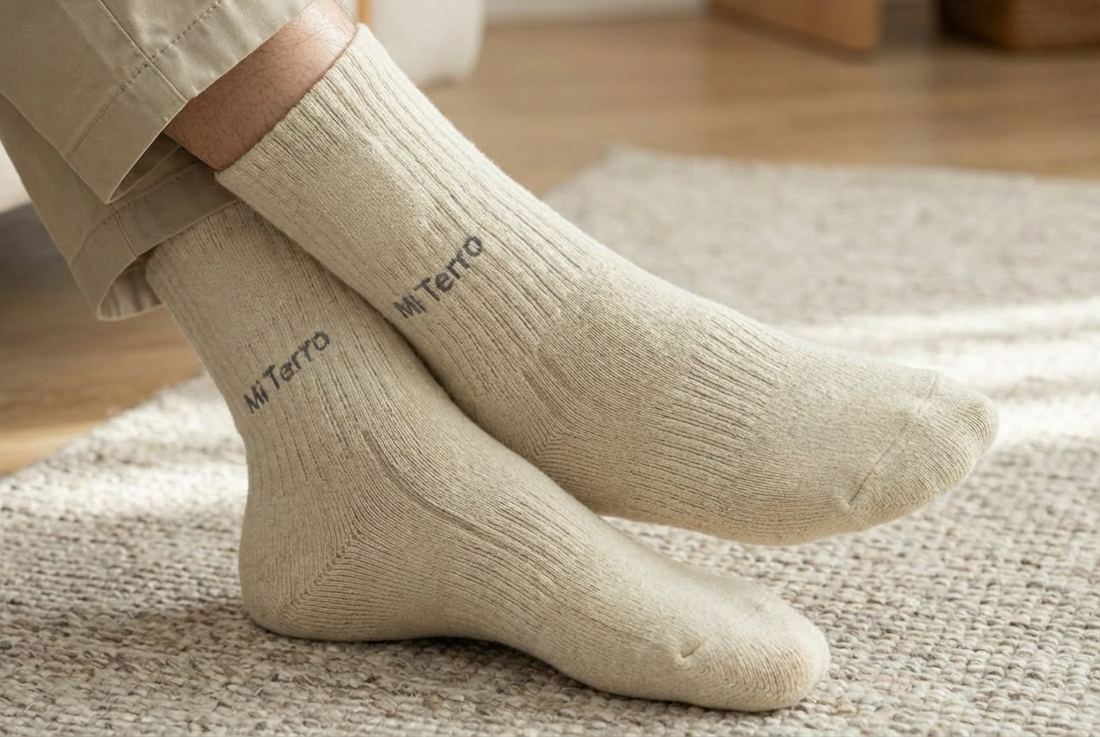
How Do Siren Socks and Mi Terro Care Socks Compare in 2026?
Siren Socks and Mi Terro Care Socks are the two leading smart sock platforms for diabetic foot monitoring. Both embed sensors directly into the sock fabric to detect early signs of foot complications — but they differ significantly in what they sense, who they serve, and how much they cost.
Siren raised $43 million proving that smart socks are a real, clinically meaningful product category. Mi Terro builds on that validation with multi-signal sensing, consumer-direct pricing, and the first-ever gout monitoring capability in a sock.
Sensor Technology: Temperature Only vs Multi-Signal
Siren Socks uses 6 NTC thermistors per sock to measure plantar temperature. When left-right temperature asymmetry exceeds 2.2°C (4°F), the system alerts a licensed nurse. This is the clinically validated threshold established by Lavery et al. in Diabetes Care (2004), which showed temperature monitoring reduces diabetic foot ulcers by up to 87.5%.
Mi Terro Care Socks embed 6 temperature sensors plus 5 piezoresistive pressure sensors per sock — 11 sensors total. This enables three simultaneous monitoring modalities:
- Temperature monitoring for inflammation detection (same clinical basis as Siren)
- Gait analysis for fall risk assessment and neuropathy progression tracking
- Pressure distribution mapping for weight-bearing abnormalities that lead to ulcers
No other smart sock on the market combines all three sensing modalities.
Who Are They Designed For?
Siren targets diabetic patients exclusively. The product is distributed through insurance-covered prescriptions at approximately $299 per pair and includes nurse-monitored care.
Mi Terro targets three patient populations:
- Diabetic patients (Type 1 and Type 2) — the same core market as Siren
- Gout patients — 9.2 million US adults with zero existing wearable monitoring options
- Elderly aging-in-place adults — at risk of falls, needing zero-effort compliance design
Mi Terro is available direct-to-consumer at $59.99 initiation plus $29.99 per month.
Feature Comparison Table
| Feature | Siren Socks | Mi Terro Care Socks |
|---|---|---|
| Temperature Monitoring | Yes (6 sensors) | Yes (6 sensors) |
| Gait Analysis | No | Yes (IMU + pressure) |
| Pressure Mapping | No | Yes (5 zones) |
| Target Patients | Diabetes only | Diabetes + Gout + Elderly |
| Gout Monitoring | No | Yes — first to market |
| Machine Washable | Yes | Yes |
| Requires Charging | No | No |
| Requires Smartphone | Yes | No (hub-based) |
| AI Baseline Learning | Basic thresholds | Personal ML baselines |
| FDA Status | Class I registered | Class I planned |
| Pricing | ~$299/pair (insurance) | $59.99 + $29.99/mo |
| Total Funding | $43M | Raising $10M seed |
Elderly Compliance: Why It Matters
The biggest challenge in health wearables is not technology — it is compliance. Smartwatches see 30-40% abandonment rates among elderly users because they require daily charging, screen interaction, and Bluetooth pairing.
Siren Socks eliminate charging but still require a smartphone for data access.
Mi Terro Care Socks require nothing from the user — no charging, no screen, no smartphone. Data transmits automatically through a wall-plug hub. In beta testing, Mi Terro achieved 87% daily wear compliance across 150+ users over 8 weeks — the highest reported compliance for any health wearable targeting elderly users.
The Bottom Line
Siren validated that smart socks are a real, clinically meaningful category. Mi Terro expands that category with multi-signal sensing, gout support, consumer-direct pricing, and elderly-first design. For patients who need more than temperature monitoring — or who cannot access insurance-covered devices — Mi Terro Care Socks offer a more comprehensive and accessible solution.
Frequently Asked Questions
Are smart socks covered by insurance?
Siren Socks are available through insurance-covered prescriptions. Mi Terro Care Socks are currently direct-to-consumer at $29.99 per month, with Medicare RPM billing planned for provider channels at $120-180 per patient per month.
Which smart sock is better for gout?
Mi Terro Care Socks are the only smart sock designed for gout monitoring. They detect temperature spikes at the hallux (big toe) combined with pressure sensitivity changes that indicate early gout flare activity.
Do smart socks really prevent amputations?
Clinical studies show temperature monitoring reduces diabetic foot ulcers by up to 87.5% (Lavery et al., Diabetes Care, 2004). Siren's published data shows 68% fewer ulcers and 83% fewer amputations among monitored patients.