Can Smartwatches Detect Diabetic Foot Problems?
No. Smartwatches and smart rings — including Apple Watch, Samsung Galaxy Watch, Oura Ring, and Fitbit — monitor heart rate, blood oxygen (SpO2), sleep patterns, and general activity from the wrist. While valuable for general health, they cannot detect the foot-specific complications that lead to 138,000 amputations per year in the United States.
Diabetic foot complications begin at the extremities. Reduced circulation, peripheral neuropathy, localized inflammation, and gait deterioration all manifest in the foot long before they appear at the wrist.
What Smart Socks Detect That Smartwatches Cannot
Plantar temperature asymmetry. Diabetic foot ulcers produce localized temperature elevations 2-3 days before the skin breaks down. Research by Lavery et al. (Diabetes Care, 2004) showed that a sustained difference of 2.2°C or more between corresponding zones on left and right feet predicts ulcer formation. Monitoring this prevents up to 87.5% of ulcers. No wrist device can measure plantar temperature.
Gait decline and fall risk. Changes in stride length, cadence, foot-strike pattern, and left-right symmetry are the earliest indicators of neuropathy progression and fall risk. The foot is the only place these can be measured. Wrist accelerometers count steps but cannot reconstruct gait mechanics.
Pressure distribution. Abnormal weight distribution creates high-pressure zones that lead to tissue breakdown and ulceration. Pressure mapping requires sensors at the sole of the foot — a location no wrist device can access.
Gout flare precursors. Gout attacks most commonly begin at the big toe, presenting as a sudden temperature spike combined with pressure sensitivity. A smartwatch has zero visibility into this joint.
Why Compliance Matters More Than Features
Even if a smartwatch could theoretically monitor the foot, compliance is the critical barrier for elderly diabetic patients. Smartwatches require daily charging, screen navigation, Bluetooth pairing, and software updates. Studies show 30-40% of elderly users abandon wrist wearables within 90 days.
Smart socks eliminate every barrier: no charging, no screen, no pairing, no behavior change. The user puts on socks they were going to wear anyway.
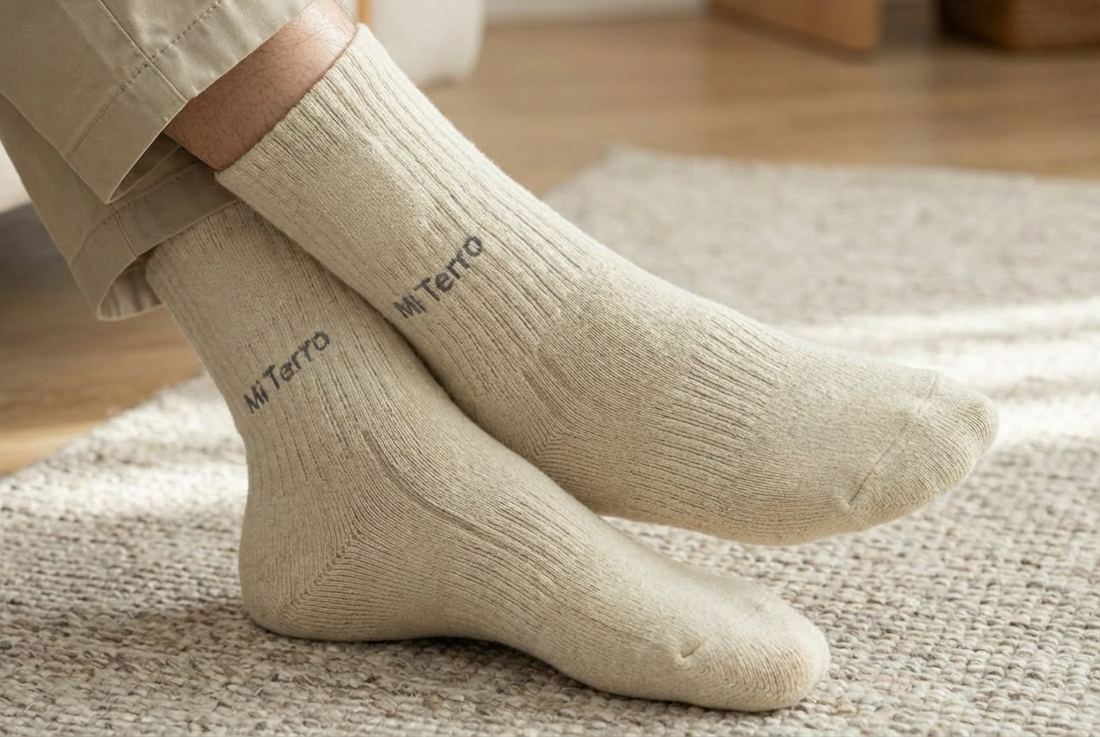
Mi Terro Care Socks achieved 87% daily wear compliance in beta testing — the highest reported rate for any health wearable targeting elderly users.
The Bottom Line
Smartwatches are excellent for heart health, sleep tracking, and fitness. They are not designed for — and cannot perform — diabetic foot monitoring, gout detection, or fall-risk gait analysis. Smart socks place sensors where the disease actually manifests: on the ground, at the foot, where it matters.
Frequently Asked Questions
Can Apple Watch detect diabetes complications?
Apple Watch monitors heart rate, blood oxygen, and activity — relevant for general diabetes management. It cannot detect plantar temperature asymmetry, foot pressure abnormalities, or gait patterns specific to diabetic foot ulcer risk.
What is the best wearable for diabetic foot care?
Smart socks with embedded plantar sensors. Clinical studies show continuous temperature monitoring in a sock reduces diabetic foot ulcers by up to 87.5%. Mi Terro Care Socks add gait and pressure monitoring for more comprehensive protection.